Brunno Fontanetti: ‘Giving advice is very unethical, because you will never suffer its consequences.’
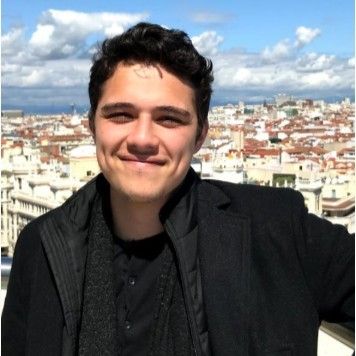
February’s Alumnus in the Spotlight is Brunno Fontanetti. He graduated in 2019 from the BSc in Economics and Business, after completing the Economics track. He now works as an Investor Relations Specialist for Stone Co in São Paulo.
What was your dream job as a child, and what is your dream job now?
I´ve always had a passion for cooking, so as a child I really wanted to be a chef. Of course (or unfortunately) at some point, reality strikes you. I then had to decide on something else to dream about, which I found quite hard. To be bluntly honest, I still haven't quite figured out what my dream job is, but I do believe I have a general idea of it. I would love to venture into entrepreneurship either by creating a company or helping structure one from scratch. And by doing so, I would somehow like to help improve this crazy wild world we live in today.
How did you get your first job?
Well, the first actual job I got was as a salesperson at an Apple reseller in Brazil. I remember right after I turned 16, which is the minimum legal age for working in Brazil, I immediately started looking for jobs, because I always wanted to have more independence from my parents. I went out to different malls and high streets handing out my CV (if you could call a paper with my name and high school grades a CV) like crazy, until this Apple reseller actually got back to me and scheduled an interview. I still remember how happy I was after getting this job. Looking back, this was a very important first step in the development of my career.
What is your current position?
I'm currently an Investor Relations (IR) Specialist working at Stone Co, a fintech specialised in financial products and software.
What do you like most about your job?
I really like the dynamism of my routine and the fact that I have contact with a lot of different people on the same day. I also really like the analytical part of it. As the structure of Stone is more horizontal, I have the opportunity to participate in different projects. For instance, peer company analysis where I scrutinise every aspect of the financial statements and strategy of our competitors and financial trade-offs more related to capital allocation and strategic decisions.
What are the most challenging aspects of your job?
Working with IR in a fintech environment is very hard, because it requires you to know every aspect of an ever-changing scene. Also, attention to detail is key here, not only for reports and such but also in what you are saying to investors, so you always have to be sharp and on point.
What was your experience studying in the Netherlands as an international student?
I couldn't have expected a better experience, quite literally, as what's great about it is exactly that you cannot expect how it will be. As a young adult, you need the correct amounts of independence, responsibility, and openness to really try to figure out what the hell is happening around you. I believe having this experience helps a lot with that. To give you an idea, my group of close friends was very diverse (8 different nationalities), which helped me see the world in many different perspectives, and this is clearly a direct result of the diverse environment you see in Amsterdam.
I remember going to an exposition in CREA where they showed pictures along with the story of people from approximately 120 different nationalities who lived in Amsterdam, and at the time I thought that was amazing. Besides all this diversity, I was also very much exposed to aspects of the Dutch culture, as I worked most of my time during uni. It didn't lead to me making a habit of drinking milk at lunch, but I am way more punctual and straightforward because of that. If I was to be so bold as to summarise my take on this experience, I would say that Amsterdam has a way of welcoming people from all around the world without losing its essence.
How do you apply what you learned in the Netherlands to your work in Brazil?
Academics-wise, I really apply what I learned in uni almost every day, from statistics to corporate finance and accounting. Having a solid base really helped me grow because it made it easier for me to get acclimated at work, understand the business better and do good analyses. Despite the very tangible results I see every day at work from my experience studying in the Netherlands, I strongly believe the most important part is not tangible. The personality traits and work ethics I developed during my experience there are the most used and important things I got from it.
What career advice would you give students and fellow alumni?
A philosophy teacher of mine once said that giving advice is very unethical, because you will never suffer the consequences from it. I like this because it helps us understand that every person has their own journey, and that's why no one should try to be someone else. However, there is some general advice I would give to people, specially to students.
First: things usually are better than what we think, and we tend to become very myopic in stressful situations. For instance, losing an exam from uni or failing a subject won´t dictate how your life is 5 years from now. Second: compete only with yourself. Third: enjoy everything about uni life, not only studying or partying – do both at your finest. And finally: Don´t drink Dutch coffee. Trust me, I´m Brazilian.
We thank Brunno for sharing his experiences and his honest advice!
Questions?
If you have any questions for Brunno, you can reach out to him on his LinkedIn page.
We hope this month’s alumnus was an inspiration. What kind of Economics and Business career would you like to know more about? Let us know and we will try to arrange an interview with alumni who have experience in that field for a future instalment of Alumni in the Spotlight!